Wednesday, September 28, 2005

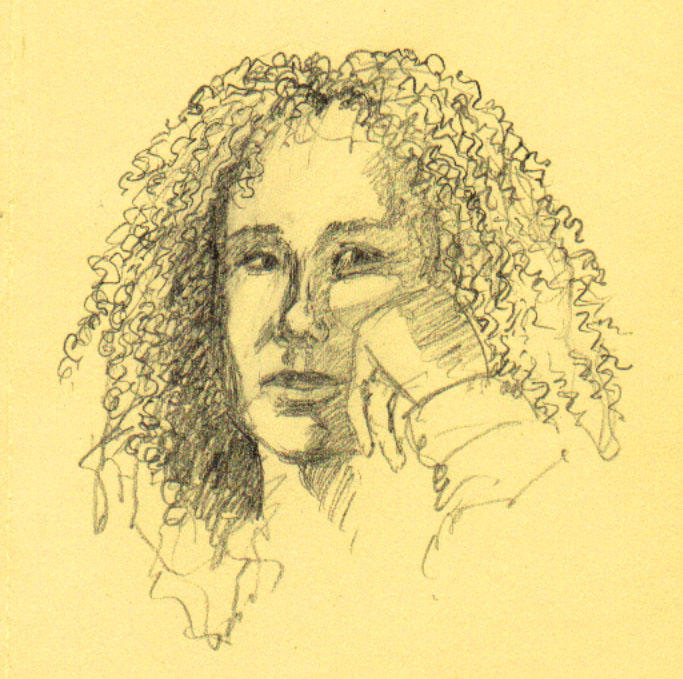
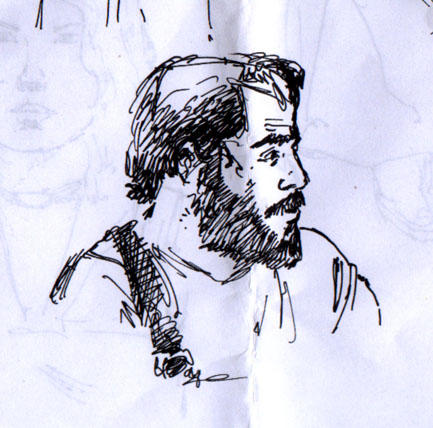
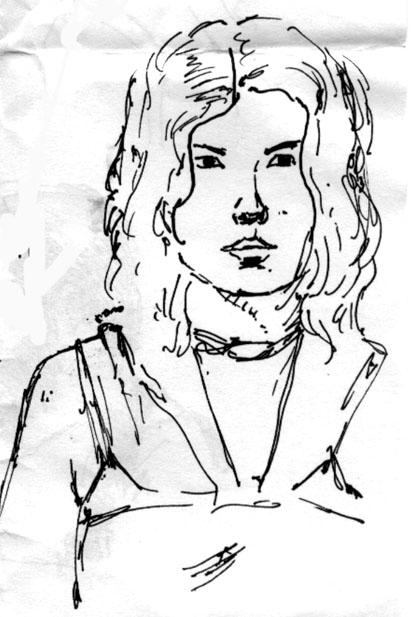
Pictures from the party, not the Party (2)


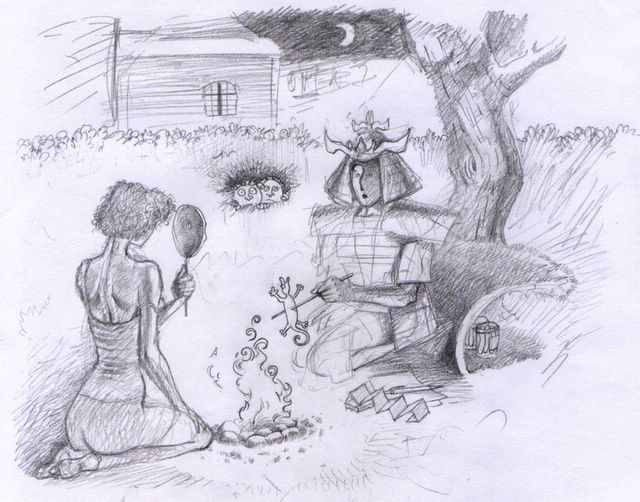
Them Damned foreigners! :)

Pictures from the party, not the Party (1)


Don't get turned on just yet, comrades: I'm still not voting for you :)
But don't be sad, either, I'm also not voting for the competition. Electorally speaking I am just like one of those pesky little virgins that put out to nobody until you just cannot stand them or their precious little booty :)
(I might vote for myself, and even there I'd be suspicious!)

But it would make a nice campaign picture, wouldn't it? (hint, hint) :)

Monday, September 05, 2005

So long and thanks for all the thrills


Thanks for bringing me to Leningrad, comrade. :)

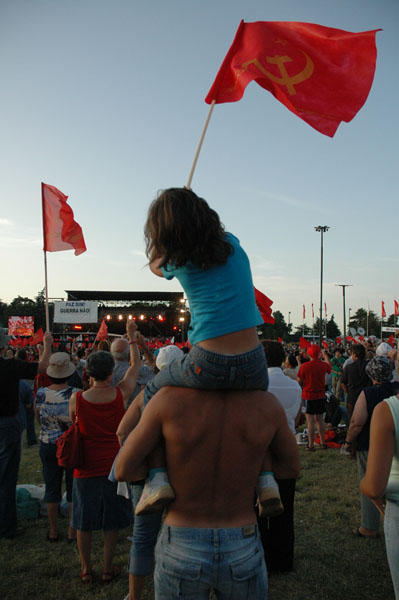
The locals have probably guessed by now where these crumpled drawings have come from. In Portugal there is something called "Festa do Avante", a yearly festival organized by the Portuguese Communist Party, but attended by people of all political colours (even the sort of individualistic no-party freaks like me - the only "parties" I trust are the recreational ones). I had never attended it until this year when my friend sort of dragged me into it. Well, after three days, and now that it is over, I can say that I have not yet been converted to the Communist Party but I certainly have been converted to the Party of the Communists.

Communism may not work, but communists surely do! :)

The festival cannot be compared to any other that I attended, and this thanks mainly, not to the events, but to the people. The festival comes together from the selfless giving of volunteer work, and it is full of passion and dedication, that shows everywhere from how well things work to how friendly the staff is, even as the day is ending and everyone is surely exhausted to the point of collapse. This is not an ideologically neutral fact. There is a coming together that cannot happen in an ideology like capitalism, dependent upon hard competition for its success. Cooperation - that is circumstancial in capitalism but central to Communism - is the key to this.

Whatever our political affiliations, this spirit of generous and selfless cooperation is someting that must be salvaged. It is surely something that might be adequately taught to a child, far before she is ready for the subtle forms of directed egoism that make capitalism work (undirected egoism, of course, needs no teaching as it comes far too naturaly to most children). Ii is something that should survive whatever else may be built on top. Essentials should not be forgotten.

A casual note: Go to most festivals or parties and notice how most of the beautiful girls parade themselves. They parade their beauty as if on display, hidden behind glass, haughty, jealous, snob, distant, complete with a metaphorical price tag. I have always found this quite repulsive. Even in that respect there was a difference at this festival: In the way they danced, walked, talked, the girls where giving their beauty away, with open smiles, natural friendliness, and genuine happiness...

PS: In case you were wondering, the mention of "leningrad" comes from the simple accident that shostakovich was being played as I first arrived at the event.

Sunday, September 04, 2005

more victims of the siege of Leningrad


The victim turned out to be a pretty good duelist herself, and the three of us (plus a late arrival - Dartagnan?) began to stalk for fresh prey. Here's a couple of them!
Dartagnan (unlike some people who will not be mentioned but only guessed at >:->) had the decency to bring his own drawing apparatus! :)

Reminds me: Dear Dartagnan (yes, that's you, Daniel!), don't forget to send me those photos!

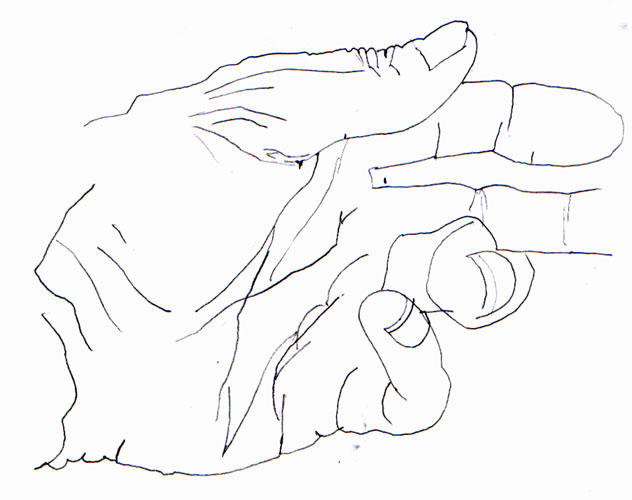
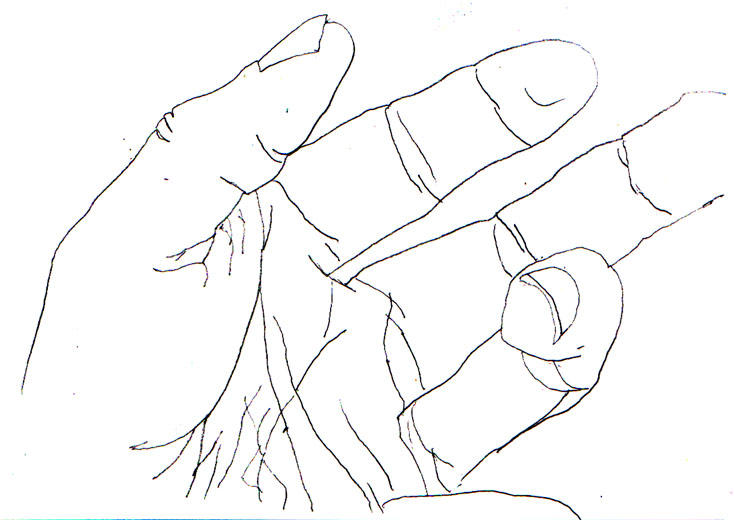
PS: What the hell was I thinking when
I drew that hand???

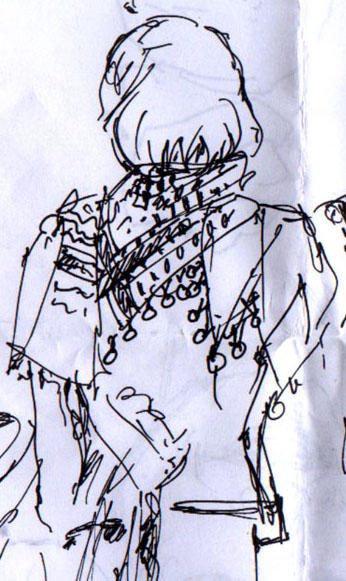
The "victim"


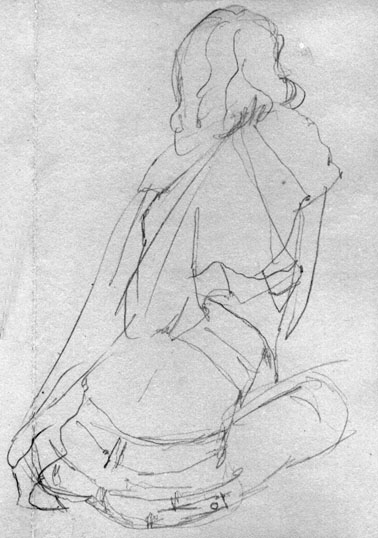
The "victim" of a drawing duel, our dear "PLO refugee", responsible for my perilous stay at the walls of Leningrad (thank you!). My drawing is so badly made not even her mother would recognize her, so anonimity is not at stake, but still, since she's paranoid about her secret identity (my dear halucinating sonambulist, you are NOT a real secret agent! :)) I'll only show her back until I get a clear "from the higher ranks" :)).

PS: I badly want one of those scarfs!

still at walls of Leningrad - day 2


An encounter with a fellow duelist at the walls of Leningrad. Thanks for the great conversation, R., and thanks for the great duel. Next time try to bring your own pencil and paper, will you?! :)

By the way, could you send me a scan of your drawing of our "victim"? I still think it is cuter than mine. :)

Wednesday, August 24, 2005


Bored. A small sketch of no importance, from a magazine photograph of some actress. Lisbon is too hot and empty for the hunting of fleeting pictures in public transportations...

Wednesday, August 17, 2005

What foot fetish?


I have no idea of what you're talking about! I do not have a foot fetish!

Monday, August 15, 2005

Howl

Im am listening to the ghostly voice of Allen Ginsberg reciting, no, intoning, Howl. No, Howling it, really.


(...)who cut their wrists three times successively unsuccess-
fully, gave up and were forced to open antique
stores where they thought they were growing
old and cried, (...)


I have the obvously fake, but honest recolection that I spent the whole day on it, though objectively it takes little more than twenty minutes to get the job done, and I only listened to it about three times.

It sounds like a mixture of the indifferent reciting of stock quotes by a cold, busy, crackling machine, and the angry intoning of ancient, magically incomprehensible latin mass in an old cathedral by a blind, mad, castrating prophet of doom.

(...)who demanded sanity trials accusing the radio of hypnotism & were left with their insanity & their hands & a hung jury,

who threw potato salad at CCNY lecturers on Dadaism
and subsequently presented themselves on the
granite steps of the madhouse with shaven heads
and harlequin speech of suicide, demanding instantaneous lobotomy,

and who were given instead the concrete void of insulin
Metrazol electricity hydrotherapy psychotherapy occupational therapy pingpong & amnesia,

who in humorless protest overturned only one symbolic
pingpong table, resting briefly in catatonia, (...)


Ginsberg, crop of 97 for the grim reaper, fits adequately enough into this somber parade of the recently deceased...

Sunday, August 07, 2005

The list goes on, and on, and on...

Clifford Truesdell was another one...I actually know someone who met him. She claims she was "not impressed". I bet the feeling was mutual. He was gone in 2000. I remember stumbling upon the news, a small reference somewhere. I felt a beautiful part of the world had crumbled before I had spotted it. Some sport news of the day had a bigger share of the same page.

Or Julian Jaynes, gone in 1997, author of "The Origin of Consciousness in the Breakdown of the Bicameral Mind", a book titled obviously and deliciously without any help of an advertisement department. Academia received it badly, apparently, as it was too controversial and academia hates anything that does not fit into a grant request. Also, it was actually a great read for the non-specialist, which is a crime these days. A book of such wonderful audacity that I will love it forever even if it is utterly wrong in its bold claims. That would merely transform it into epic poetry of the highest caliber.

Or Robert Beverly Hale...Some people walk around with the memories of his lectures on artistic anatomy...Lucky bastards...I can only dream of a videotape...

Or...so many others...

Obituaries are a wonderful, sad thing. Following up on the names above can change your life...each one of them changed mine a great deal. I invoke each one as one would an ancient incantation. I just wish I could meet some live oracles for a change...My personal Delphi is getting too full of ghosts for my taste...

Forwarding address: Unknown

It is not only that interesting people keep dying before I get the chance to meet them, but they seem to enjoy making their exit slightly before or just after I learn of them. I remember when I found the preliminary version of E. T. Jaynes "Probability Theory: The Logic of Science" on the web. Right on the first few chapters it clarified in one fell swoop what had been to me an intellectual swamp until then. I had no idea who Jaynes was, I just knew I owed him an immense debt. I was compelled to write him an email that was really above all a way of saying thanks. It also included a question on a particular point. It took me some time to write it down. When I finally considered it ready I went to look for his email on the page...only to find that he had died just a few years before, and the page was actually handled by someone else. I cannot describe how that unexpected revelation shocked me. There was a special type of emptiness created by the fact that I had written him a letter, that now had no possible recipient. The words just hovered there, useless. I kept wondering: "where do I send it to?". Quite definitely, his forwarding address was utterly unknown...

Caem como tordos...

Spent the afternoon looking at some drawings, paintings and photos, by Zdzislaw Beksinski, only to find, while sniffing around wikipedia, that he is already dead. Why do interesting people keep falling dead around me? Can somebody tell me? I am not old enough for this. Really I'm not.

Am I?

Thursday, August 04, 2005

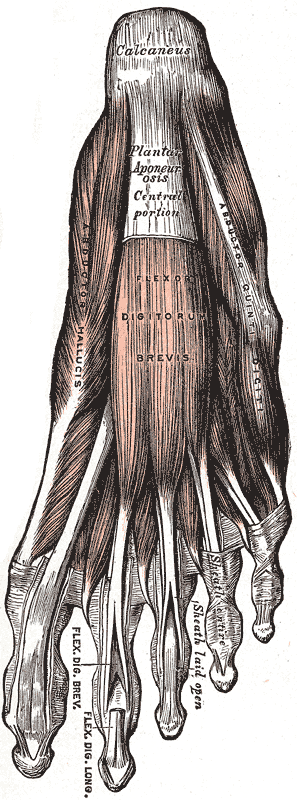
The Flexor Digitorum Brevis prayer


God grant me the serenity to accept that some joints cannot be moved independently;
the ability to move independently the joints that can;
And the wisdom to know the difference.

It is August. It is too hot for posting. And reading up on anatomy can drive you to madness. :)

(illustration from Gray's Anatomy, which, by the way, is freely available online)

Sunday, July 24, 2005

Zen and the art of blind contour drawing

Still on the subject of MaDi's question: Blind contour drawing is, or should be, an exercise of intense concentration, better done in a Zen-like state. There is a passage from the Mahabharata that goes something like this:

Drona was testing his students one day. He placed a bird on a tree and asked each one to take aim with his bow. Then he asked: ”What do you see?”. The first one said “I see the bird. I see the tree. I see the clouds behind the tree. I see the arrow. I see my hand”. Drona was vexed by this and did not allow him to shoot. He repeated this with the others, with the same results. Finally Arjuna took aim. Again, Drona asked the question:

-What do you see?
-I see a bird
-Describe the bird!
-I cannot.
- Why not?
-I can only see its eye.
-Release the arrow!-ordered Drona. Arjuna did so and the arrow pierced the bird’s eye.

While doing a blind contour drawing, never allow yourself to see too much. The point you are drawing is enough.

Saturday, July 23, 2005

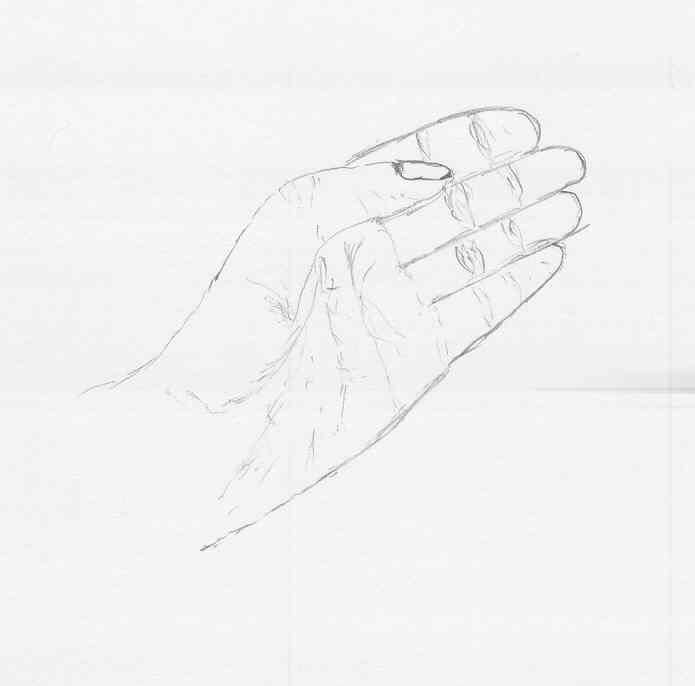
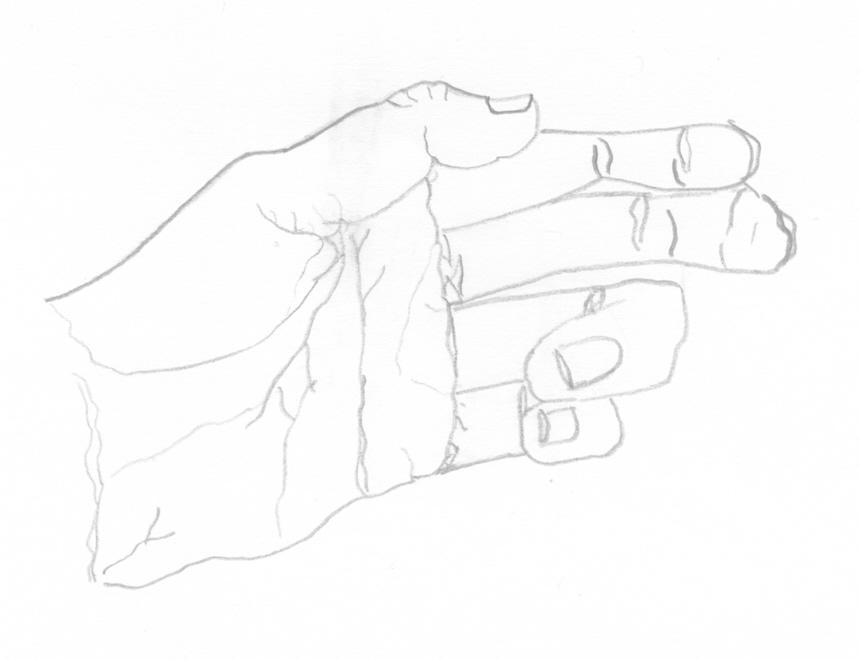
MaDi's amazing blind contour drawing diet. Or: before/after - satisfaction guaranteed or your money back :)


fig 1


fig 2


MaDi, a reader of this blog, sent in these two pictures. The second one was done according to the directions of the exercise. Notice the thumb. Unlike the first drawing, you can see here the steep angles where the phalanges meet, and the one where the first phalange of the thumb meets the metacarpal (trapezium) bone. MaDi did not suddenly take anatomy lessons: she just started looking. She did not name body parts, but she drew them, and she felt them “through the skin”, and became aware of their effect on contour. Also, note how the rendering is so much more forceful when instead of messing around with small timid lines as in the first picture she just boldly advanced with a single motion for better or worse. The other fingers did not go as well, however. Why? MaDi told me she got confused with the more complex position of the fingers in 3D space. The solution to this is simply to follow the exercise scrupulously. You should not even realize there is such a thing as a finger lying in 3D space. Just move over each line. Do not see the fingers. Do not see even a single finger. Do not see a nail. Just focus on each line. Focus so much that you don’t see anything else. Use tunnel-vision (and Tunnel-thinking. Better yet, do not think at all during this exercise!). Then what you see is very simple. A line, on paper can only have a tangent whose angle with the horizon goes between 0 and 360 degrees. Any such line is as easy to draw as any other. Therefore any position of the finger is as easy to draw as any other - as long as you see each line in turn, never the finger.

This, of course, requires great concentration.

Monday, July 18, 2005

After the exercise


Since you were not looking at the paper, the drawing will probably be a mess, globally, with lots of lines that fail to intersect properly (see the examples above). Do not worry, this is normal (notice however how amazingly accurate your drawing is, locally). The point is that through this exercise you made a direct connection between the model and the paper. And most of all, you observed the model very carefully. You started to see what was really there, beyond symbol, beyond what you think you know. And, no matter how awkward the drawing looks, you have drawn something that is an actual, detailed observation of the object: a direct experience of it, not a symbol. Notice that the amount of detail you can get in is just limited by what you can see (depending on light conditions, distance and eyesight) and by the amount of time you take. If you go really slowly you can find a dozen crests on what can seem a single straight line in a faster drawing. You’ll be amazed at how detailed you can get. And how much you can learn of what a hand, face, foot, whatever, really looks like.

This is a student’s first liberation from his symbolic machinery. By going down in scale, the symbolic part of your visual brain has lost focus. It does not apply at the scale of simple, small, meaningless contour lines, therefore it shuts down and frees you to be able to actually look and, very simply, copy what you actually see.

Exercise: Blind Contour Drawing

Place your pencil on the paper. Focus your eyes on a point on the model, any point that lies on a contour line. As you do this, feel as if the tip of your pencil is touching not the paper, but the point on the model. Make sure you convince yourself of this. Make sure you feel it. Then, and only then, start to move your eye slowly along the contour line. At the same time, your pencil should travel, equally slowly, on the paper, following the same motion as the eye. As you feel your way over the lines of the model, the pencil should draw the contour on the paper. Move your eyes slowly on the model’s contour line, move your hand slowly on the paper, following the same motion, BELIEVING that your hand is touching the model. NEVER look at the paper. You are NOT drawing on the paper, you are drawing on the model. Believe that it is the model’s skin you are feeling and not the paper, pressing against your pencil. When a contour ends behind another one you are allowed to look at the paper, just to place the tip where the new contour begins. Then repeat the process. Do this until you are too tired to go on. There is no such thing as a real ending anyway.

Preamble to the exercise:


outline of a hand(red)


contour of a hand(yellow)

There are zones on a body that are naturally represented by contours on a piece of paper. This is symbolic too, but at a very low-level. You do not need to be taught what I mean by contour since your visual brain already has special circuitry designed to detect contours. You may need however to be advised that by contour I do not mean outline. A simple example will suffice. Watch these photographs for examples of outline versus contour. In red you see the outline. It is a single line, the border of the projection of the hand onto the plane of the picture. In yellow you see the contour. Unlike outline, Contour gives you information about all three dimensions of an object, about aspects of its surface and about its spatial orientation and its bulk. I have drawn only a few of the lines. You can draw hundreds, depending only on how closely you are prepared to look. As you can see, contour lines have a beginning and an end. They often, but not always, disappear behind other contour lines (sometimes they just fade - the distinction will matter for the exercise). Contour lines are not projection border lines, but lines that you would naturally follow by using your sense of touch if you were caressing the surface. They include lines were curvature changes abruptly, like crests and folds. They include the border itself, although not as a simple uninterrupted line. Isn’t it true that you naturally follow the border with your fingers when you caress someone? Here you look at the border as that part of the picture where the object turns away from you and hides behind its own front plane, creating an inticing jump in colour and a line of high contrast against the background. Lovers are expert at following such lines with their fingers. When in doubt, hire them as consultants...

2 – Avoiding symbols – “Draw what you see”

People like Betty Edwards (author of "Drawing on the right side of the brain") will tell you that in order to draw you have to forget the symbols and draw what you see. This is a great revelation for a beginner. Such simple words tell you so much. Drawing is much enhanced by such simple mantras:
Forget the symbols. See with your eye.

Forget sticks and circles. Watch each line. Copy each line. Forget that this is an arm, that this is a hand. How to draw hands? Are hands hard? Hands are not hard. Faces are not hard. Hands, faces, feet, eyebrows, are just lines standing there. Copy each line and in the end you’ll have a hand. But if you see at as a hand, you’ll just draw a symbol of it. So, forget the hand. See this line. See that line. Draw each one. The hand will surface by itself.

Kimon Nicolaïdes, in his excellent book, "The natural way to draw", will go much the same way (some critics of B. Edwards will say that her book is just Nicolaïdes techniques with a lot of pseudo-neurology B.S. added in – I disagree, but that’s another story). He will tell you to “touch” the model with your eye, to “see” not only with your eyes but with your five senses (in fact, mostly with a sort of tele-tactile sense– we’ll speak of this later, too). Again, he is telling you to forget symbols, and react directly to the image in front of you. There is always a translation, but it is no longer symbolic, conceptual – it is a physical translation, just as direct as the device that turns the pattern of grooves on a record into sound, though much more personal, unreliable, unpredictable. This is cybernetics with stochastic perturbations.

Before I speak of the third stage I think an exercise is in order. I’ll try to explain what “blind contour drawing” is before we proceed.

1 – The first symbolic stage

At first we draw in symbols. A circle is a head. A line is an arm. We do it because circles and lines are easy to draw. But mostly we do it because they are expedient symbols, and because we have not observed, really observed, more details than those symbols can transmit.

The symbols are useful. They are easy to draw and they transmit with perfection a lot of information. They are economical. This first state of drawing is highly efficient. But we must go further and leave this heaven if we want to observe more details.

Sunday, July 17, 2005

Forget Art

Forget Art for a second. Forget aesthetics. There is a sense to the word “drawing” that precedes aesthetics and Art. The distinction must be forced. This is dissection. This is physics 101, this is the motion of a sphere in a vacuum. Just as in physics, such artificialities are useful and foment understanding.

Problem: Suppose you have a face in front of you, or a body. You want to preserve what you see right now. You want to preserve it on paper with a pencil or a pen, you want to translate it into dirt that stays on the sheet. Cameras have not been invented. How do you go about it?

Truth is approached by a succession of useful falsities. What follows is a sketch of the usual phases of drawing. There are others possible sketches. This will do for now.

This will set the scenario of what drawing usually is. Much later I’ll discuss what the purpose of it all is for me. And why drawing can go beyond being just so much dirt left on a piece of paper, as long as you stop looking at drawings and start doing them yourself – drawing as a verb, not as a noun, drawing as a martial art and Zen sitting, drawing as illicit lovemaking. This is not a discussion of what drawing is in itself (that would require terrible arrogance), but of a few of the faces it may have. It is a personal thing.

Saturday, July 16, 2005


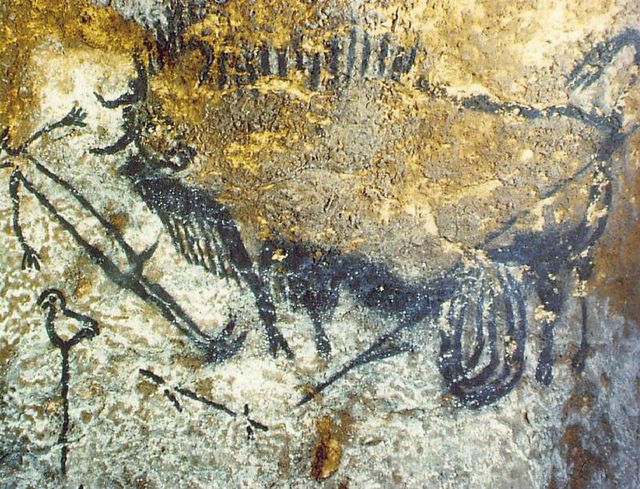
Wounded Bison and Man


How early is the symbol programmed into a child?
One wishes to draw what is there. One wishes to learn how to see.

Often I thought I wanted to see like a child again, without learned symbols to cloud my vision - Zen mind, beginner's mind, I'd repeat to myself - yet, even a child draws in symbols, so how can that be the proper direction?

How early does the symbol get embedded into the brain? Do we learn it as children? Are we being taught somehow, subreptitiously, from a line that goes back to ancient cave painters, or were ancient cave painters really artistic children and what we observe in children is simply that in a way (biologists, forgive me the abuse) "Ontogeny recapitulates phylogeny"? Does the artistic development of the individual recapitulate the artistic development of the species?...

Maybe all this is well known. Can any anthropologist in the room tell me this: If I draw the stick figure of a man, how many cultures will recognize it? Is it universal, or specific? Is it inscribed in our ancestral genes or is in an artifact of a few civilizations?

Friday, July 15, 2005

The Vitruvian Stick-Man


The Vitruvian Stick-Man

In what way is the previous drawing worse than the one preceding it?

In what way, if any, it it better?

Children draw stick figures because they think in symbols.

Most adults draw much in the same way because, like children, they still think in symbols.

Artists draw differently because they see beyond the symbol. They see what is there.

...or do they?

Make it simple :)

or "Para quê complicar, quando podemos simplificar?" :)

Wednesday, July 13, 2005

for Macha K


for Macha K, the misterious chambermaid of Sossego Hotel,
with thanks for all the little seeds, the nice chats by the moonlight, and, above all, all those duels to the death. (apologies to my non-Portuguese-speaking readers who won't understand at all what this post is about :))